Wednesday, 2 May 2018
Tuesday, 19 September 2017
Sash Window Care and Operation Guide
The sash window or vertical sliding window was the most
ingenious product of the seventeenth-century and has found
acceptance by over half the western world.
Sash windows have influenced the architecture of buildings for
more than two centuries and the whole design of buildings was
constructed around the grace and dignity of the sash window.
The traditional appearance and the operational effectiveness
including some refinements have been incorporated into
today’s modern PVC-U sash windows.
Unlocking the window -
If you have key locks, insert the key into the locking cam catch and turn to unlock.
Turn the cam catch anti-clockwise through 180 degrees to open.
Limit Stops - Some windows may have limit stops fitted on the top sash. This opening restrictor allows for the top or bottom sash to be opened to a set position of 100mm. This needs to be pressed in or locked in position using the black nylon key provided to allow the sash to travel past it.
You will now be able to slide the sashes up and down freely.
Ventilation - Vents can be fitted to the top rail of top sash. If fitted slide the cover sideways to open the vent to the desirable position. Care should be taken that the bottom sash does not contact the vent as this may cause damage to the internal vent cover. If you have K3 two stage keeps fitted you can lock the window closed or slightly open for ventilation.
All about cleaning your windows & operating the tilt facility (if fitted)
The most significant difference between the modern PVC-U sash window and its traditional window equivalent is the tilt facility that enables safe cleaning from the inside.
PVC-U should be cleaned at periodic intervals to maintain the original pristine appearance. The frequency depends on the geographical location and the local environment but as a general rule the frame should be cleaned whenever the glass is being done.
1)Slide the bottom sash clear of the cill up-stand. This releases the interlocks that prevent drafts from between the top and bottom sash.
2)Slide the tilt knobs towards the centre of the sash (tilt knobs are located on the top of the bottom sash at either side).
3)Gently pull towards you until the tilt rest arms on the side of the sash engage and take the weight of the sash.
- The top sash can be operated in the same manner when the bottom sash has already been opened. 4)Wipe over the plastic profiles with a damp cloth, working from the top of the top sash to the bottom of the bottom sash.
5)Clean the glass using water based glass cleaner or soapy water. NB: When cleaning a window it can be difficult to clean the external travel stops. Should you be tempted to remove for cleaning, do not slide the sash as the balances can be overstretched and thus permanently damaged. After closing the sash, give a slight pull towards you to ensure the sash has latched into the frame properly.
• Wipe the white rubber seal on the bottom of the bottom sash to maintain a good white finish.
• Ensure the drainage holes located on the bottom of each sash are clear to allow for drainage.
• Clean the grey brush pile to ensure good seal against drafts.
• Use silicone spray or a beeswax polish to lubricate the sliding components. If the window starts to stick or squeak, NEVER use oil based products on your sash windows.
• Clean the outside pane of the top sash first. When complete, return the sash to a vertical position and then clean the inside pane.
Apply the same procedure to the bottom sash. After cleaning it is absolutely essential to check all tilt latches have re-engaged. Do not forget to reset any Limit Stops after cleaning
What chemicals to use to clean the PVC-U?
The best method of cleaning is to use a clean cloth and a solution detergent such as Flash or Fairy liquid diluted to the normal concentration for floor cleaning or washing up.
If the surfaces are excessively dirty or unsightly and stains remain, then a mild nonscouring cream such as Cif can be applied.
Most suitable window cleaning detergents are probably already in use in the majority of households.
NB: Avoid at all times solvent based cleaners and abrasive materials because of scratching and especially the use of steel wool pads as these may cause permanent scratches. If you follow these instructions your windows will look good and operate as well as the day they were installed.
The sash window or vertical sliding window was the most
ingenious product of the seventeenth-century and has found
acceptance by over half the western world.
Sash windows have influenced the architecture of buildings for
more than two centuries and the whole design of buildings was
constructed around the grace and dignity of the sash window.
The traditional appearance and the operational effectiveness
including some refinements have been incorporated into
today’s modern PVC-U sash windows.
Unlocking the window -
If you have key locks, insert the key into the locking cam catch and turn to unlock.
Turn the cam catch anti-clockwise through 180 degrees to open.
Limit Stops - Some windows may have limit stops fitted on the top sash. This opening restrictor allows for the top or bottom sash to be opened to a set position of 100mm. This needs to be pressed in or locked in position using the black nylon key provided to allow the sash to travel past it.
You will now be able to slide the sashes up and down freely.
Ventilation - Vents can be fitted to the top rail of top sash. If fitted slide the cover sideways to open the vent to the desirable position. Care should be taken that the bottom sash does not contact the vent as this may cause damage to the internal vent cover. If you have K3 two stage keeps fitted you can lock the window closed or slightly open for ventilation.
All about cleaning your windows & operating the tilt facility (if fitted)
The most significant difference between the modern PVC-U sash window and its traditional window equivalent is the tilt facility that enables safe cleaning from the inside.
PVC-U should be cleaned at periodic intervals to maintain the original pristine appearance. The frequency depends on the geographical location and the local environment but as a general rule the frame should be cleaned whenever the glass is being done.
1)Slide the bottom sash clear of the cill up-stand. This releases the interlocks that prevent drafts from between the top and bottom sash.
2)Slide the tilt knobs towards the centre of the sash (tilt knobs are located on the top of the bottom sash at either side).
3)Gently pull towards you until the tilt rest arms on the side of the sash engage and take the weight of the sash.
- The top sash can be operated in the same manner when the bottom sash has already been opened. 4)Wipe over the plastic profiles with a damp cloth, working from the top of the top sash to the bottom of the bottom sash.
5)Clean the glass using water based glass cleaner or soapy water. NB: When cleaning a window it can be difficult to clean the external travel stops. Should you be tempted to remove for cleaning, do not slide the sash as the balances can be overstretched and thus permanently damaged. After closing the sash, give a slight pull towards you to ensure the sash has latched into the frame properly.
• Wipe the white rubber seal on the bottom of the bottom sash to maintain a good white finish.
• Ensure the drainage holes located on the bottom of each sash are clear to allow for drainage.
• Clean the grey brush pile to ensure good seal against drafts.
• Use silicone spray or a beeswax polish to lubricate the sliding components. If the window starts to stick or squeak, NEVER use oil based products on your sash windows.
• Clean the outside pane of the top sash first. When complete, return the sash to a vertical position and then clean the inside pane.
Apply the same procedure to the bottom sash. After cleaning it is absolutely essential to check all tilt latches have re-engaged. Do not forget to reset any Limit Stops after cleaning
What chemicals to use to clean the PVC-U?
The best method of cleaning is to use a clean cloth and a solution detergent such as Flash or Fairy liquid diluted to the normal concentration for floor cleaning or washing up.
If the surfaces are excessively dirty or unsightly and stains remain, then a mild nonscouring cream such as Cif can be applied.
Most suitable window cleaning detergents are probably already in use in the majority of households.
NB: Avoid at all times solvent based cleaners and abrasive materials because of scratching and especially the use of steel wool pads as these may cause permanent scratches. If you follow these instructions your windows will look good and operate as well as the day they were installed.
C & L Windows and Conservatories Ltd
65, Seymour Road
Gloucester
Gloucestershire
GL1 5PT
01452 526028
65, Seymour Road
Gloucester
Gloucestershire
GL1 5PT
01452 526028
www.candlwindows.co.uk
Thursday, 10 August 2017
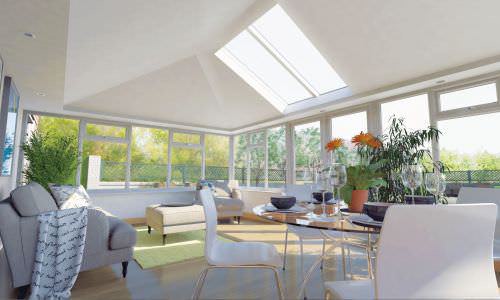
Ultra380 Conservatory Roof
UltraRoof380’s lightweight tiled roofing system gives you the most advanced replacement roof available on the market today.
UltraRoof380 overcomes the twin issues of your old conservatory being too hot in summer and too cold in winter. Moreover, it creates a beautiful vaulted plastered ceiling inside - and on the outside a stunning lightweight tiled finish.
For those who want a solid roof but still want to retain an element of light within the room, the clever configurable technology in the UltraRoof380 allows the installation of multiple glass panels or Velux Windows – this can help project light into the adjacent room and give you a truly bespoke design.
Extremely thermally efficient due to its advanced design, UltraRoof380 is fully compliant with Building Regulations and has jhai system approval, giving you peace of mind from the outset of your replacement roof project.
At the ridge and hips of your roof you can choose between a modern aluminium capping or a more traditional tile roof capping, once again giving you a choice of design for your roof.
The external fascia boards are available in different colour choices to match or contrast your existing window frames: White, Black, Rosewood, Oak.
Depending on your preference, full glazed panels or Velux windows can be inserted into the roof to enable natural light to flood into the room. High performance glazing can be used to further enhance the experience of your new room. This glass can help reduce glare from the sun and control the amount of heat that you allow into the space.
Choose from Three Tile Colours:
Internally the UltraRoof380 is second to none. Around the perimeter of the ceiling sits an internal pelmet which can be used to insert spotlights or speakers and at the apex of the roof you can choose to add a fl at panel enabling you to insert down lights or hang pendant lights for main or mood lighting.
UltraRoof380 has a proven pedigree and will provide comfort and peace of mind for many years to come. The complete roof is pre manufactured to ensure consistent quality on site and speedy installation with minimal waste and minimal disruption to your home compared to other tiled roof solutions.
C & L Windows and Conservatories Ltd
65, Seymour Road
Gloucester
Gloucestershire
GL1 5PT
01452 526028
65, Seymour Road
Gloucester
Gloucestershire
GL1 5PT
01452 526028
www.candlwindows.co.uk
Thursday, 8 June 2017
Wednesday, 24 May 2017
Heritage Sculptured Sash
- Smooth contours
- Welded transom and mullion joints
- Unique optional horn sash
- Exquisite Georgian bar option
- Traditional ironmongery options
- High energy rating and weather performance
- Enhanced security PAS 24 Approved
- Double or triple glazing available
- Low Maintenance PVC-U frames
- Available in a range of hand-picked Heritage woodgrain finishes
Sculptured Sash windows feature outward opening sashes which stand proud of the face of the window frame and are the more typical style used in homes you see today. For that period property look, Sculptured Sash windows can also feature a dummy sash, this simple but effective upgrade to achieve “equal sight-lines” can really enhance the beauty of your home.
This range is ideal for period properties and those who want to add character and enhance the appearance of their homes. The stunning and individual aesthetic of this range makes it a market leader.
Premium Woodgrain Foils in
|
Super Efficient
Compared with aluminium or wood, PVC-U windows are low maintenance, have better insulation values and are able to reduce energy and heating costs. | |
Your Ideal Home
The Deceuninck Heritage Sculptured Sash sits perfectly in any property, whether it be a modern town house, a quaint country cottage or even a period home. | |
Sound-Proof
Glazing options to maximise energy efficiency and/or sound proofing. | |
Safe and Secure
For total peace of mind, our Heritage Sculptured windows come with multi-point locking as standard. |
Tuesday, 23 May 2017
Friday, 28 April 2017
Solidor Front Doors
Welcome home! Your Front door is the heartbeat of your home – it gets the most use, protects you from the elements and it keeps you safe. Whether you’re planning a whole house renovation or a simple lick of paint, the impact of a new front door can transform any property. That’s why thousands of home lovers across the country have chosen a Solidor to enhance and protect their home. With Solidor you can find a front door that sets the style for your property and gives you essential protection from the outside world. Whether your style is traditional or contemporary, maybe you’re looking for a standard size or perhaps you’d like a door which is bespoke. Solidor has everything you need!
The most secure composite door available on the market
• 100% recycled thermally efficient reinforcing system
• 5 chamber lead free thermally efficient profile
• Extensive recycling programme
• Door can be recycled at the end of its useful life, not destined for land fill
• Fully manufactured in the UK to minimise our carbon footprint
• Lead free door skins and edge banding
SOLIDOR CONSTRUCTION
Lead free, 5 chamber profile with 100% recycled reinforcing
Thermally efficient Solid Timber Core
Robust through colour thermo plastic skins
Realistic wood grain effect or smooth finish
Optional integral mobility access aluminium threshold
A TYPICAL FOAM FILLED CONSTRUCTION
Only a small section of the door is actually solid
Thermally good, but foam filled so not solid, nor secure
Gel coated GRP may be strong but it scratches very easily and can be cut through
Most other doors have frames containing lead stabilizers. The | frames are only 3 chambers thick and use valuable steel or aluminium reinforcements
Our Green Credentials
Timber can make a significant contribution to sustainable construction 1. Wood is naturally renewable 2. It is independently certified to be sourced from sustainably managed forests 3. Doors with timber cores save energy 4. They last longer 5. They add to our quality of life 6. They have fewer environment
The most secure composite door available on the market
• 100% recycled thermally efficient reinforcing system
• 5 chamber lead free thermally efficient profile
• Extensive recycling programme
• Door can be recycled at the end of its useful life, not destined for land fill
• Fully manufactured in the UK to minimise our carbon footprint
• Lead free door skins and edge banding
SOLIDOR CONSTRUCTION
Lead free, 5 chamber profile with 100% recycled reinforcing
Thermally efficient Solid Timber Core
Robust through colour thermo plastic skins
Realistic wood grain effect or smooth finish
Optional integral mobility access aluminium threshold
A TYPICAL FOAM FILLED CONSTRUCTION
Only a small section of the door is actually solid
Thermally good, but foam filled so not solid, nor secure
Gel coated GRP may be strong but it scratches very easily and can be cut through
Most other doors have frames containing lead stabilizers. The | frames are only 3 chambers thick and use valuable steel or aluminium reinforcements
Our Green Credentials
Timber can make a significant contribution to sustainable construction 1. Wood is naturally renewable 2. It is independently certified to be sourced from sustainably managed forests 3. Doors with timber cores save energy 4. They last longer 5. They add to our quality of life 6. They have fewer environment
C & L Windows and Conservatories Ltd
65, Seymour Road,
Gloucester
Gloucestershire
GL1 5PT
(01452) 526028
www.candlwindows.co.uk
Thursday, 30 March 2017
Composite Doors - The Royal Collection
The Royal Composite Door is carefully finished in the UK, every door is uniquely altered to suit the individual requirements of the homeowner;
The Royal collection offers 22 door styles and many decorative Glass options, combined with carefully chosen colour finishes there are literally hundreds of combinations;
The Royal Door is a combination of traditional looks and advanced manufacturing techniques. Although looking like a traditional timber door, our composite door are manufactured using grained GRP skins with a composite core that will stand the test of time, reducing your energy bills and continued to look stunning for years to come.
The Morgan and Shelby Composite Doors are available with an option of Multi-Point, Contemporary or Heritage Door Lock
The Royal collection offers 22 door styles and many decorative Glass options, combined with carefully chosen colour finishes there are literally hundreds of combinations;
The Royal Door is a combination of traditional looks and advanced manufacturing techniques. Although looking like a traditional timber door, our composite door are manufactured using grained GRP skins with a composite core that will stand the test of time, reducing your energy bills and continued to look stunning for years to come.
The Morgan and Shelby Composite Doors are available with an option of Multi-Point, Contemporary or Heritage Door Lock
C & L Windows and Conservatories Ltd
65, Seymour Road
65, Seymour Road
Gloucester
Gloucestershire
GL1 5PT
Gloucestershire
GL1 5PT
01452 526028
www.candlwindows.co.uk
Tuesday, 28 March 2017
Features and Benefits of our Windows and Door
Features of the Royale Window and Door Suites
- We offer two types of window and door suites, the Classic Chamfered, and the Encore Decorative.
- Available on a smooth or grained timber effect finish as standard, complimented by a select group of alternative RAL colour
- Our window hold up to twenty five energy rated licenses between 'A' and 'C', the benefits are such that home owners are able to make considerable savings on their energy utility bills
- The classic and encore window has a fully retractable, bi-directional claw lock with shoot bolts at either end.
- Hinge protectors at the back of the sash are fitted for added security as standard to provide enhanced resistance to forced entry.
- All side openers offer easy clean fire egree hinges allowing safe passage through the window in the event of a fire.
- The millenco door bolt boasts an industry leading eight point locking system featuring 3 hooks, 2 chisel bolts, 2 cams and latch point.
- Both window and door locks hold the relevant BS kite Marks and secured by design accreditations at their respective manufacturing facilities.
- For 20 years the Royale product has been produced using state of the art CNC machinery enabling us to achieve consistently high standards of finished products, we are confident of our products and we are sure you will be extremely happy once our Windows and Doors have been installed into your home.
PVCu
Our PVCu material is supplied by the world's leading manufacturer Deceuninck. Established in 1937, Deceuninck is the world leader in PVCu systems and active in over 60 countries, employing over 3,000 people worldwide. The subsidiary is based in Calne in Wiltshire. A strong belief in ongoing investment into reasearch and development has ensured that Deceuninck lead the way in product design and innovation.
Glass
The Royale product will feature the latest low emissivity glass which complies with current government legislation and Fensa regualtions. Your Royale glazed product exceeds the centre pane u-value by 20%
Window Locks
Your property is constantly under threat from burglary, so much so that in recent years a range of different security products have been made available to home owners. Royale window locking system is a 'secured by design' licensed product and has been thoroughly assessed by B.S.I (British standards institute) and B.B.A (Bristish Board of Agreement). Also this product has achieved BS7950
- Enhanced casement window security
- 4 Locking points for each opening window
- Guaranteed security
- Quality & durability beyond the requirements of British standards
- Reverse action centre claw lock
- Shoot bolts at either end
- Night vent position
- superb corrosion resistance
- simple to use security
Door Locks
The new millenco mantis multipoint door lock is a robust, high performance product that embodies the latest leading technology. its innovative design meets and exceeds all relevant industry standards.
In producing this second generation Millenco door lock, we listened to our customers' needs and associated problems very carefully prior to design, to ensure the highest levels of security could be obtained without compromise of fitting tolerance.
- Dual spindle for front and rear doors
- Anti tamper lock cases
- Reduced handle operating force.
- Three hook locks
- Two chisel bolts
- two compression power cams
- one centre latch
- Lock complies with Pas23/24 and certified secure by design
So with all of this in mind, and if it is your time to change your existing windows or doors then we could be the company for you! Why not give us a call and arrange a free no obligation quotation. 01452 526028
Tuesday, 10 January 2017
Trickle Vents - Meeting regulations
The Building Regulations in England and Wales require ‘that there shall be adequate means for ventilation provided for people in the building. It however now differentiates between windows for residential installation in either a Replacement or New build application.
Replacement windows
If the window being removed has trickle vents fitted, then the replacement window should also have them – to the same level of performance.
The ventilators fitted to the replacement window should therefore offer at least the same capacity as the ventilators fitted to the removed window.
Typically these ventilators will be either 4000mm2 or 2000mm2 in their geometric free area.
Where it is not possible to ascertain the capacity of the outgoing vents;
- Habitable rooms should have a minimum of 5000 mm2 EA*
- Wet rooms should have a minimum of 2500 mm2 EA*
*Equivalent Area EA, figures will vary for Scotland, Northern Ireland and Eire.
If the window being removed did not have trickle vents fitted, it is recommended to provide the background ventilation in the replacement window, due to the health benefits.
Additional Guidance for Replacement Windows within England and Wales
The Building Regulations Requirement F1 – Means of ventilation, states:
There shall be adequate means of ventilation provided for people in the building.
When assessing a property for replacement windows the following should be considered regarding the use of trickle ventilators and other forms of ventilation within replacement windows:
- Trickle ventilators are not mandatory unless the existing windows have them, however it is always good practice to consider their use when replacing windows. Alternatively ventilators may be replaced by an air brick.
- Replacement ventilators must be no smaller in geometric open area than the existing ventilators. If the geometric area is not known, habitable rooms should have trickle ventilator of 5000mm2 equivalent area and wet rooms should have 2500mm2 equivalent area.
- Although not mandatory, increasing ventilation by the provision of new or additional ventilators to maintain good air quality should be considered between the supplier and the customer (ref: GGF publication “Advice to consumers regarding ventilation when replacing windows”).
- Two stage locking handles are an acceptable form of trickle ventilation, where security is not compromised and draughts will not create a problem. This would usually mean not on the ground floor.
- The provision of permanent ventilators for combustion appliances is a different matter and compliance with Approved Document J is mandatory
New Houses
Ventilation levels within a house or dwelling are dependant upon a number of factors. Guidance tables can be found within Approved document F – or alternatively ventilator manufacturers maybe able to assist.
England and Wales
Basic requirement is 5,000 mm2 EQA for a habitable room.
Overall calculations are by floor area.
Total equivalent ventilator area (mm2) for a new dwelling with a designed air permeability leakier than (>) 5 m3/(h.m1) at 50 Pa (EQA)
This is based on two occupants in the main bedroom and a single occupant in others. For a greater level of occupancy, assume a greater number of bedrooms. For more than five bedrooms, add 10000 mm2 per bedroom.
Building Regulations Part F (England & Wales)
A systems approach
Due to the increasing complexity of the Regulations, ventilation strategies and system design must be considered at the earliest stages of building design.
3 three ventilation types:
"Whole Building" background ventilation to provide fresh air to dilute and disperse low levels of water vapour and pollutants, usually by the provision of background ventilators or mechanical supply ventilation.
"Local extract" extract ventilation in rooms where most water vapour or concentrated pollutants are released.
"Purge" rapid ventilation for the rapid dilution and removal of high concentrations of pollutants from occasional activities, usually by opening windows as set out in Appendix B of Part F.
Approved Systems of Ventilation
Background Ventilation & Intermittent Extract:
This method requires background ventilators with at least 5000 mm2 EQA in habitable rooms with external walls and a combination extract and background ventilators with at least 2500 mm2 EQA installed in wet rooms.
Passive Stack (PSV) & Background Ventilation:
This method requires the installation of a stack system into wet rooms/kitchens with background ventilators with at least 5000 mm2 EQA fitted in all habitable rooms with external walls and background ventilators with at least 2500 mm2 EQA installed in wet rooms not containing PSV units. Open flued appliances still require air supply as given in approved document J.
Continuous Mechanical Extract Ventilation:
Continuous mechanical extract ventilation is an alliance of a central extract unit and trickle ventilators to ensure fresher air is drawn through the property. All habitable rooms require 2500 mm2 of equivalent area to ensure property does not dry out.
Continuous Mechanical Supply & Extract,with Heat Recovery:
No requirement for trickle vents.
The performance for each “System” approach set out in Part F are the minimum requirements needed. The occupant’s health could be at risk if they are compromised.
Systems may be manually or automatically controlled. For each system air must be able to flow through the dwelling. The Regulations make provision for this via internal door undercuts to maintain a minimum gap of 10mm above the finished floor. This provides a 7600mm2 permanent opening when a door is closed.
E.g. System 1 – Intermittent extract fans and background ventilators. This is the most commonly used system in the UK.
Where can it be used?
It is suitable for use in houses and flats or apartments with multiple façades. In some circumstances, especially in dwellings with a single façade.
How does it work?
The system comprises of background ventilators, fitted to windows and extract fans fitted in moisture producing areas or “wet rooms” (kitchens and bathrooms). The background ventilators provide the whole building ventilation and also supply air to the intermittently operated extract fans which provide the extract ventilation.
How are ventilation rates calculated?
Guidance on minimum provisions for extract and whole building ventilation is set out in tables of Approved Document.
The whole building ventilation rate for background ventilators is determined by a number of factors:
- Dwelling floor area
- Number of bedrooms, occupants, storeys and number of façades.
What benefits does it offer?
- Simplicity
- Operation familiar to most occupants
- Straightforward installation
- Inhabitants control
What difficulties could we encounter?
- Perceived high running costs
- Noise potential of low quality or poorly installed fans
- Single façade dwellings require additional background ventilators fitted at low level
Specific Ventilator requirements - approved F1 revised document 2006
- Ventilator areas are now described in terms of equivalent area, as opposed to the geometric measurement.
- Where replacement windows are fitted, these must have Ventilators if the old units contained them. Ideally vents should be fitted in all cases.
Performance-based Guidance introduced
- What level of ventilation should be sufficient, rather than how it should be achieved.
- The designer has the freedom to use whatever ventilation provisions suit a particular building.
Standard Requirements
- All Vents to be Marked with Equivalent Area in a visible location.
- All trickle vents must now be tested to BS13141-1:2004.
Ventilator Location
- Ventilator should be typically located at 1.7 metres from finished floor level, this is to avoid the potential discomfort of draughts.
- Single façade properties where both ‘High’ and ‘Low’ level ventilation is required, low level should be approx, 1 metre below the high level ventilation.
- When using intermittent extract fans, the frame vent should be located at least 0.5 metre’s from the extract fan.
Vent opening configuration and method used to calculate equivalent area @ 1Pa.Tested to EN 131141.
- New Build Dwelling – The trickle ventilation requirement for a house is based upon the overall floor area and number of bedrooms. (Dependent on ventilation method used.)
- Existing Dwellings – Trickle ventilators supplied in all rooms, 5000mm2 minimum in habitable rooms, 2500mm2 in wet rooms.
- Regulations now apply to Conservatories and Extensions
Friday, 16 December 2016
New Heritage Window and Door Collection
When it comes to selecting the right products to enhance and protect your home, you want to be sure you’re making the right choice. Beautiful, stylish, expertly made, our PVC-U Sculptured and Flush Sash windows and doors strike the perfect balance between energy efficiency, security and design
Key Features
Sculptured Sash windows feature outward opening sashes which stand proud of the face of the window frame and are the more typical style used in homes you see today. For that period property look, Sculptured Sash windows can also feature a dummy sash, this simple but effective upgrade to achieve “equal sightlines” can really enhance the beauty of your home.
This range is ideal for period properties and those who want to add character and enhance the appearance of their homes. The stunning and individual aesthetic of this range makes it a market leader.
No. 1 for Colour
Colour Express is a unique range of foil colours in 18 colourways for our full suite of windows and doors, helping homeowners choose the perfect colour palette for their home. Complete with colour matching ancillaries, trims and accessories windows and doors have never looked so pretty. Supplied from stock, everything - windows, residential and composite doors, the Slider24 patio door and Slide & Swing – door - arrives together to minimise inconvenience and disruption.
The Heritage Colour Collection is our new range of six premium woodgrain colour foils, available on our full suite of Heritage 2800 windows and doors. Beautiful White Woodgrain inside as standard with the option of English Oak and White Woodgrain on the outside; or English Oak inside and outside. Supplied from stock, your colour windows and doors arrive on the same lead time as white. Choose from eight colourways, all with matching ancillaries, trims and accessories for a perfect match
Heritage Sculptured Sash windows look great in any surrounding; modern townhouse or country cottage, its subtle charm and elegance transforms the building like no other
Super Efficient
Compared with aluminium or wood, PVC-U windows are low maintenance, have better insulation values and are able to reduce energy and heating costs.
Your Ideal Home
The Deceuninck Heritage Sculptured Sash sits perfectly in any property, whether it be a modern town house, a quaint country cottage or even a period home.
Sound-Proof
Glazing options to maximise energy efficiency and/or sound proofing.
Safe and Secure
For total peace of mind, our Heritage Sculptured windows come with multi-point locking as standard.
C & L Windows and Conservatories Ltd
65, Seymour Road
Gloucester
Gloucestershire
GL1 5PT
65, Seymour Road
Gloucester
Gloucestershire
GL1 5PT
01452 526028
www.candlwindows,co.uk
Wednesday, 14 December 2016
TOP TEN TIPS TO BEAT CONDENSATION
TIP 1:
Keep your home well ventilated by opening windows every day. You should also make sure that the drip vents in your windows are open as these allow additional airflow that will combat condensation. If you have condensation on windows it is likely that it will be elsewhere in your property too.
TIP 2:
When you are cooking always turn the extractor fans on in the kitchen on a high power. This will extract any excess moisture from boiling pots and pans. If possible, open up the kitchen windows whilst cooking for extra ventilation. It is an idea to leave the extractor fan on for longer than you are cooking as there will be excess moisture in the air which you cannot see.
TIP 3:
After taking a bath or shower there will be excess moisture in the air. To stop condensation forming, the bathroom windows should be opened and extractor fans turned on. Try to keep the bathroom door shut as much as possible so the moisture doesn’t escape into other parts of your home.
TIP 4:
When you are drying your clothes you should dry them outside where possible. If you cannot do this then put them in an enclosed room and keep the window open. If you use a tumble dryer to dry your clothes it is extremely important that the ventilation pipe runs to the outside of your property.
TIP 5:
You should leave a small gap between the walls of your home and your furniture as this allows the air to move away from the bottom of the walls and circulate around the room. If air lingers between the furniture and walls it will condense onto walls and could eventually form into black mould
TIP 6:
Your property’s airways such as airbricks and chimneys should be clear to allow airflow in and out of your home. Air ventilation is extremely important as you don't want moist air to be trapped in one part of your home as it will condense on your walls.
TIP 7:
During the winter and at other cold times of the year you should try to maintain a constant temperature in your home. This is because it is cold air that causes the warm air to release moisture. If the air is all the same temperature then this cannot happen
TIP 8:
Always keep the lids on pots and pans whilst cooking so that the moisture does not escape from the pans. If the lids are off moisture will be rising from the pans even if you cannot see it. Just as you can only see your breath in the air on a cold day, you can only see the moisture rising from a pan when the temperature is lower.
TIP 9:
Check your roof to see if there are any problems such as water leaking in.
TIP 10:
Check the guttering and down pipes, make sure that they are carrying the water away and that there are no damaged/blocked guttering or drainpipes causing the external wall to become soaking wet.
C & L Windows and Conservatories Ltd
65, Seymour Road
Gloucester
Gloucestershire
GL1 5PT
65, Seymour Road
Gloucester
Gloucestershire
GL1 5PT
01452 526028
www.candlwindows.co.uk
Tuesday, 13 December 2016
8 Things to Know About Windows
1. Leaky and inefficient windows, and glazed doors account for more than 25 percent of the average household's energy bills. You can cut energy costs by as much as 15 percent by buying double glazed windows.
2. Cut noise with insulated or double-glazed windows featuring 1/4 inch to 1 inch of air (or argon) between the panes. Wider air spaces and thicker glass reduce noise more.
3. Useful Life: Most manufacturers say windows should be replaced after about 20 years. Signs of a failing window include being sealed, draftiness, and panes that collect condensation, ice, and frost.
4. Aluminum: Strong, affordable, and low-maintenance, but conducts heat and cold.
5. Composites: Stronger and more durable than wood and vinyl, and priced between the two; can be painted to match a home's decor.
6. Low-emissivity (low-E) glass has a thin metallic coating that reflects heat back to its source, keeping heat inside the house in the winter and out of it in the summer. Low-E coatings also reduce energy costs and block UV rays while allowing 95 percent of natural light to pass through
7. Maintenance free – Most manufacturers today offer an exterior window that requires little or no maintenance. Other than cleaning and inspection of the caulk joints on an annual basis, you should enjoy many years of worry free maintenance to your windows and trim. Windows made of vinyl, fiberglass, composite material, aluminum clad wood, vinyl clad wood or all aluminum will provide you with varying degrees of low maintenance. Most will eliminate the need to paint on a regular basis which will save on your painting bills.
8. Aesthetics – New windows can provide a new or updated look. They also can match your original home and blend in architecturally while providing energy saving benefits. Many manufacturers feature multiple color choices for the exterior and hardwood interiors for that special look. Grid options or style of window give you the opportunity to totally change the look on the outside. There are so many new options for color, hardware, grids, and interiors now available that you can truly personalize your windows to match your individual tastes
2. Cut noise with insulated or double-glazed windows featuring 1/4 inch to 1 inch of air (or argon) between the panes. Wider air spaces and thicker glass reduce noise more.
3. Useful Life: Most manufacturers say windows should be replaced after about 20 years. Signs of a failing window include being sealed, draftiness, and panes that collect condensation, ice, and frost.
4. Aluminum: Strong, affordable, and low-maintenance, but conducts heat and cold.
5. Composites: Stronger and more durable than wood and vinyl, and priced between the two; can be painted to match a home's decor.
6. Low-emissivity (low-E) glass has a thin metallic coating that reflects heat back to its source, keeping heat inside the house in the winter and out of it in the summer. Low-E coatings also reduce energy costs and block UV rays while allowing 95 percent of natural light to pass through
7. Maintenance free – Most manufacturers today offer an exterior window that requires little or no maintenance. Other than cleaning and inspection of the caulk joints on an annual basis, you should enjoy many years of worry free maintenance to your windows and trim. Windows made of vinyl, fiberglass, composite material, aluminum clad wood, vinyl clad wood or all aluminum will provide you with varying degrees of low maintenance. Most will eliminate the need to paint on a regular basis which will save on your painting bills.
8. Aesthetics – New windows can provide a new or updated look. They also can match your original home and blend in architecturally while providing energy saving benefits. Many manufacturers feature multiple color choices for the exterior and hardwood interiors for that special look. Grid options or style of window give you the opportunity to totally change the look on the outside. There are so many new options for color, hardware, grids, and interiors now available that you can truly personalize your windows to match your individual tastes
C & L Windows and Conservatories Ltd
65, Seymour Road
Gloucester
Gloucestershire
GL1 5PT
65, Seymour Road
Gloucester
Gloucestershire
GL1 5PT
01452 526028
www.candlwindows.co.uk
Monday, 12 December 2016
Windows and Doors
Introduction
If you are thinking about changing your
windows or doors you will need to think about U-values. A U-value measures of
the rate at which heat escapes through a fabric, so the lower the figure, the
better. A U-value of zero means that no heat is escaping. It is
expressed as Watts per square metre (W/m2) but it is really only the
number that matters.
Double and triple glazing
Double or triple glazed windows are
another form of insulation. However, as you can see from the figures below, it
is not generally so efficient as wall and roof insulation. Replacing a
single-glazed window with a reasonable quality double-glazed unit will more
than halve the heat loss.
The Energy Saving Trust estimate that
you will save £165 a year by replacing single glazed windows with B-rated
double glazing. You will also reduce noise from outside, and experience less
condensation.
However, only about 10 per cent of the
total heat loss from the house is through the windows, so there is really no
point in putting expensive double-glazed windows in un-insulated walls.
Similarly, it's only worth investing in the best triple glazed windows if you
have super-insulated the property first.
Glazing
Standard windows will have air in the
gaps between the panes of glass. Higher performing ones tend to have argon or
other gases between. They will also have a low-E (low emissivity) coating. This
allows the heat from the sun into a room, but reduces the amount that escapes
again.
Frames
UPVC are a low maintenance option.
However, the Centre for Alternative Technology recommend that they should be
avoided as their production is energy intensive, and they are polluting at
manufacture and disposal.
Alternatives include wood (which needs
more maintenance), aluminium and composites which have wood on the inside and
aluminium on the outside.
New double glazing is required to have
trickle ventilation in the frame (even if the ones you are replacing do not).
This is because modern windows are more air tight than older ones.
Efficiency
Some manufacturers label their windows
with the standard A-E measures of energy efficiency
C & L Windows and Conservatories Ltd
65, Seymour Road
Gloucester
Gloucestershire
GL1 5PT
01452 526028
www.candlwindows.co.uk
Subscribe to:
Posts (Atom)